HorusOrb · Active research
Recovering the ball in three dimensions.
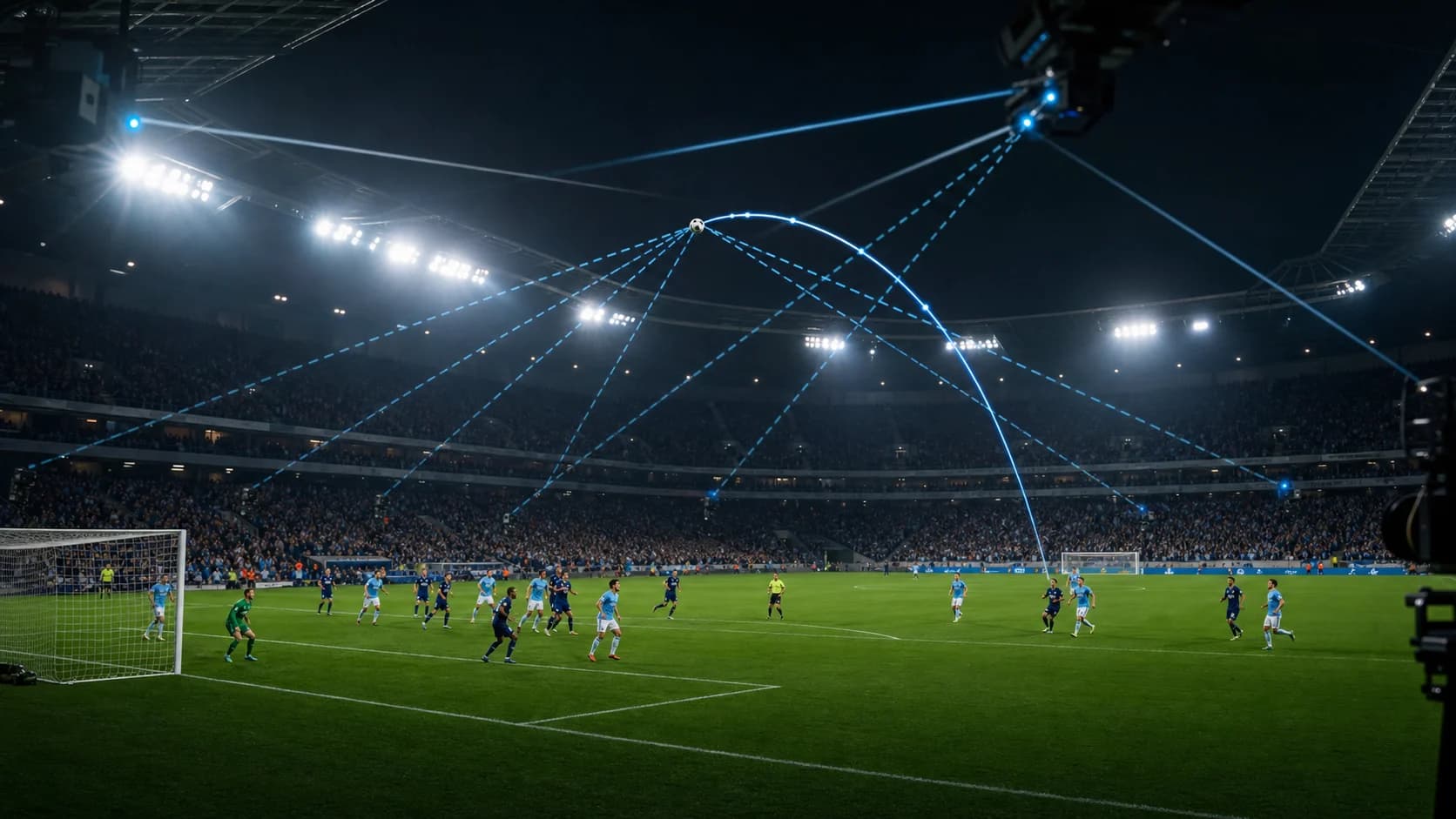
BlueX is researching how synchronized match views can support triangulated ball position, flight, and height while preserving uncertainty.
Research question
When can synchronized views support a defensible three-dimensional ball state—and when should height remain unresolved?
Why this matters
Study the behavior that changes the work.
A single camera can make a rising ball look close to the ground or hide it behind players. Three-dimensional reconstruction needs time-aligned visual evidence, a shared pitch frame, and an explicit record of what was observed versus inferred.
Triangulated evidence
Study when observations from multiple synchronized views converge strongly enough to support horizontal position and height.
Flight continuity
Connect visible and temporarily hidden observations through a plausible trajectory without presenting an inferred segment as directly seen.
Resolvable uncertainty
Separate observed, reconstructed, and unresolved ball states so later analysis can respect the quality of the source evidence.
Validation principles
Evidence before a claim.
Three-dimensional ball context could make aerial play, passing height, flight, and reception conditions accessible to football analysis without reducing the match to a flat point.
Test synchronized views across aerial play, player occlusion, camera movement, motion blur, and partial visibility.
Review horizontal position, height, trajectory continuity, and view agreement as separate evidence questions.
Keep failed or weak triangulation available for review instead of filling every moment with a generated path.
Reading standard
Evidence stays attached.
Three-dimensional ball output remains an active research program, not a claim that every match already produces reliable height.
An inferred path never replaces the synchronized source observations used to support it.
When view agreement is insufficient, the ball state remains two-dimensional or unresolved.
Research to workflow
See the result on a real match.
A pilot shows how the research becomes reviewable evidence for analysts and coaches, with clear confidence and review states.